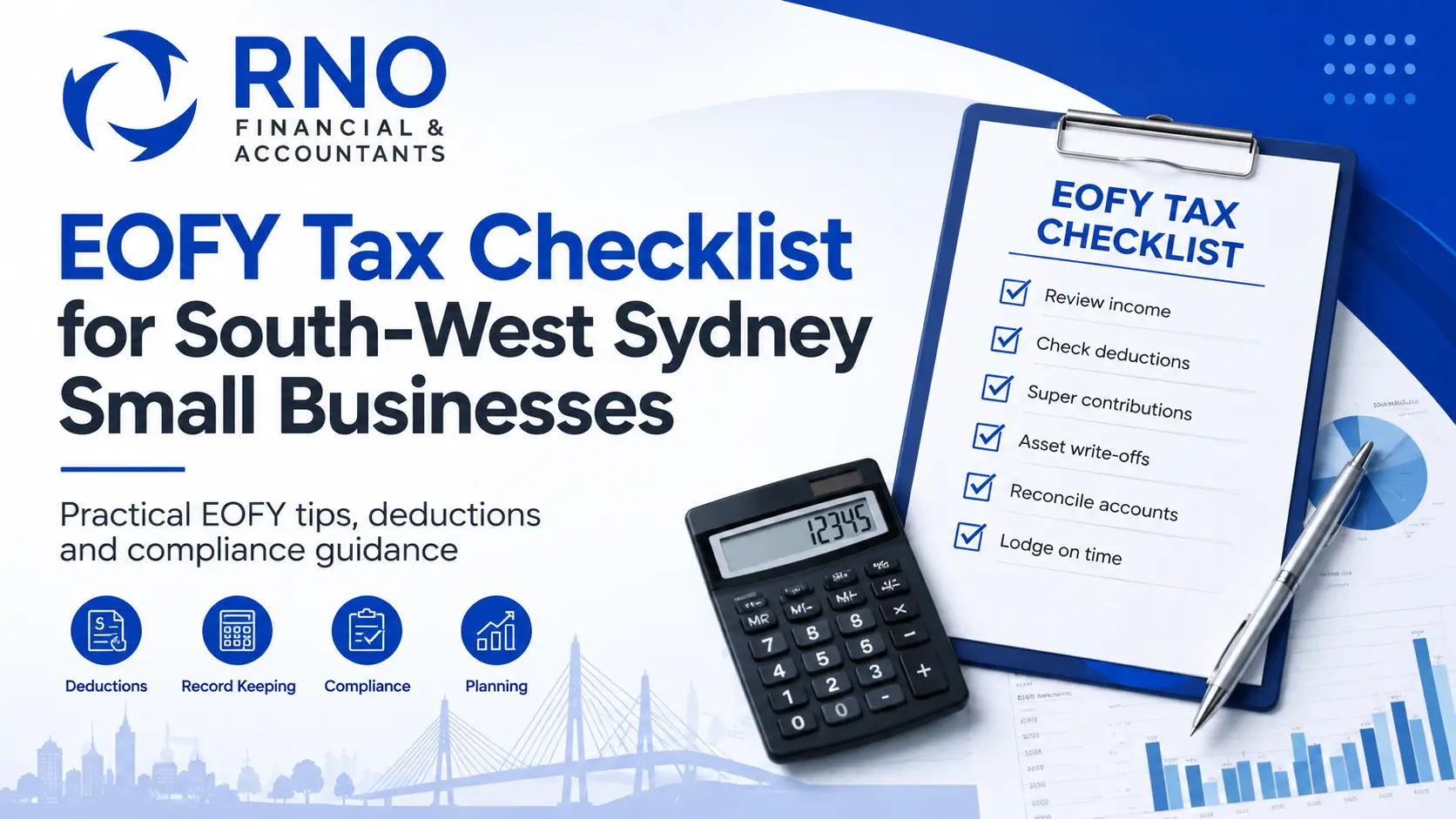
Your complete guide to closing the financial year with confidence and clarity
The end of the financial year (EOFY) in Australia — 30 June — is one of the most important dates on your business calendar. It’s not just about lodging tax returns; it’s about good record‑keeping, claiming every legitimate deduction, meeting your compliance obligations with the ATO, and planning so you kick into the next financial year stronger than before.
For small business owners in South‑West Sydney, having a structured EOFY tax checklist isn’t just helpful — it’s essential. In this guide, we take you systematically through what you need to prepare, review, finalise and plan before — and just after — EOFY, with practical hands‑on advice relevant to NSW businesses.
Understand What EOFY Means for Your Business
EOFY runs from 1 July to 30 June each year. By the time 30 June arrives, you need your books up to date, reconciled and ready to generate accurate financial reports for tax purposes. This includes income statements, balance sheets and records of all transactions that will feed into your tax return and other reporting obligations.
Getting organised ahead of time means you avoid last‑minute scramble and can take advantage of legitimate tax planning opportunities.
Your EOFY Tax Checklist (Quick Reference)
Before 30 June:
- Reconcile all financial accounts
- Collect and organise income and expense records
- Verify asset purchases and depreciation
- Ensure GST and BAS are up to date
- Confirm payroll and superannuation obligations
By 14 July:
- Complete STP finalisation (if relevant)
Early July — 31 October:
- Lodge your income tax return (or through a tax agent)
Ongoing:
- Plan financial goals and record‑keeping systems for next year
Get Your Records and Documents in Order
This is the foundation of your tax preparation — and where many small businesses fall down.
Reconcile Financial Accounts
- Make sure all bank accounts and credit cards are reconciled up to 30 June.
- Match payments received (receivables) and amounts you owe (payables).
- Check transaction coding in your accounting software (Xero, MYOB, QuickBooks or similar).
Proof of Income
- Collate invoices, sales receipts and digital payment summaries that demonstrate your business income.
- Ensure income is captured accurately for the full year.
Expense and Receipt Records
- Gather all receipts and invoices for business expenses.
- Save digital copies and back up paper records — ATO requires you to keep records for at least five years.
Review and Maximise Business Tax Deductions
One of the biggest goals at EOFY is ensuring you claim every deduction you’re entitled to. The ATO allows deductions for most expenses you incur in earning business income — provided they’re for business purposes and you’ve got evidence to substantiate them.
Common Deductible Business Expenses
- Everyday operating costs — utilities, rent, office supplies.
- Motor vehicle and travel costs where business‑related.
- Professional services fees (including your accountant).
- Insurance and licence fees.
- Repairs and maintenance.
- Depreciation of business assets.
Important ATO Notes
- You cannot claim the private portion of mixed‑use expenses — only the business percentage.
- The GST component of purchases is not deductible if you claim GST credits on your Business Activity Statement.
Leverage Instant Asset Write‑Off and Depreciation Rules
The ATO’s instant asset write‑off lets eligible small businesses claim an immediate deduction for qualifying business assets under a threshold, provided they are first used or installed ready for use in the relevant income year.
If assets exceed the instant write‑off threshold, you may still be able to depreciate them using simplified depreciation rules and a small business pool — an accounting method for spreading deductions over multiple years.
Practical tip: Plan before June 30 if you’re considering big purchases — timing affects when you can claim the deduction.
Manage Payroll, Superannuation and BAS
These compliance areas are often where penalties surface if overlooked:
Payroll and STP Finalisation
If you employ staff, you must complete Single Touch Payroll (STP) finalisation by mid‑July. This makes sure employees’ income statements are marked “tax‑ready” for their personal tax returns.
Superannuation Guarantee
Ensure all quarterly superannuation liabilities are paid — and received by the fund — before 30 June to be deductible this year.
GST and BAS
- Reconcile and lodge all Business Activity Statements (GST, PAYG, etc.).
- Double‑check your GST totals before 30 June.
Conduct Your Stocktake and Asset Review
If your business holds inventory:
- Do a physical stocktake as close to 30 June as possible.
- Write off obsolete or unsellable stock before year‑end.
Accurate stock valuation is essential, especially for businesses in retail and trade.
Also compile a complete asset register, including dates of purchase, costs and depreciation schedules.
Complete Your Tax Return and Lodge on Time
Small businesses may need to lodge:
- Income tax return (sole trader, company or trust return).
- Any mandatory reports required by ASIC (for companies).
Use your reconciled accounts, reconciled payroll figures and verified deductions to populate the numbers. A registered tax agent can ensure compliance and accuracy here.
Plan for the Year Ahead
EOFY isn’t just a deadline — it’s an opportunity to reflect and plan.
Review Business Performance
Analyse your profit and loss, cash flow and budgeting outcomes for the year so you understand what worked — and what didn’t.
Set Strategic Priorities
Plan for:
- cash flow resilience
- tax planning
- investment in growth and systems
- updated business goals and structure if needed.
Engage an EOFY Accountant in Sydney
Hiring a qualified EOFY accountant Sydney can transform this process from a time‑consuming chore to a strategic exercise. A seasoned accountant:
- flags deductions and concessions you might miss.
- ensures compliance with ATO rules.
- helps optimise your small business tax return in NSW.
- alleviates stress and reduces risk of audit adjustments.
For many small business owners, expert guidance pays for itself in tax savings and peace of mind.
Final Verdict
EOFY doesn’t have to be overwhelming. With a solid EOFY tax checklist, disciplined record‑keeping and the right professional support, small business owners in South‑West Sydney can close the year confidently, reduce their tax burden legitimately and lay strong foundations for the year ahead.If you’re unsure about any part of this process — or want to maximise your tax position — you can consult with RNO Finance and Accountants as a trusted accountant experienced in small business tax and EOFY compliance.